
Intelligent payments
Enable users of igaming sites to seamlessly share bank data and make a deposit.
Year
2025
Duration
6 weeks
Role
Lead product designer
The problem
iGaming operators have lots of data on their customers in their own ecosystem but know very little about what their customers are doing with other gambling operators (pan operator).
The outcome
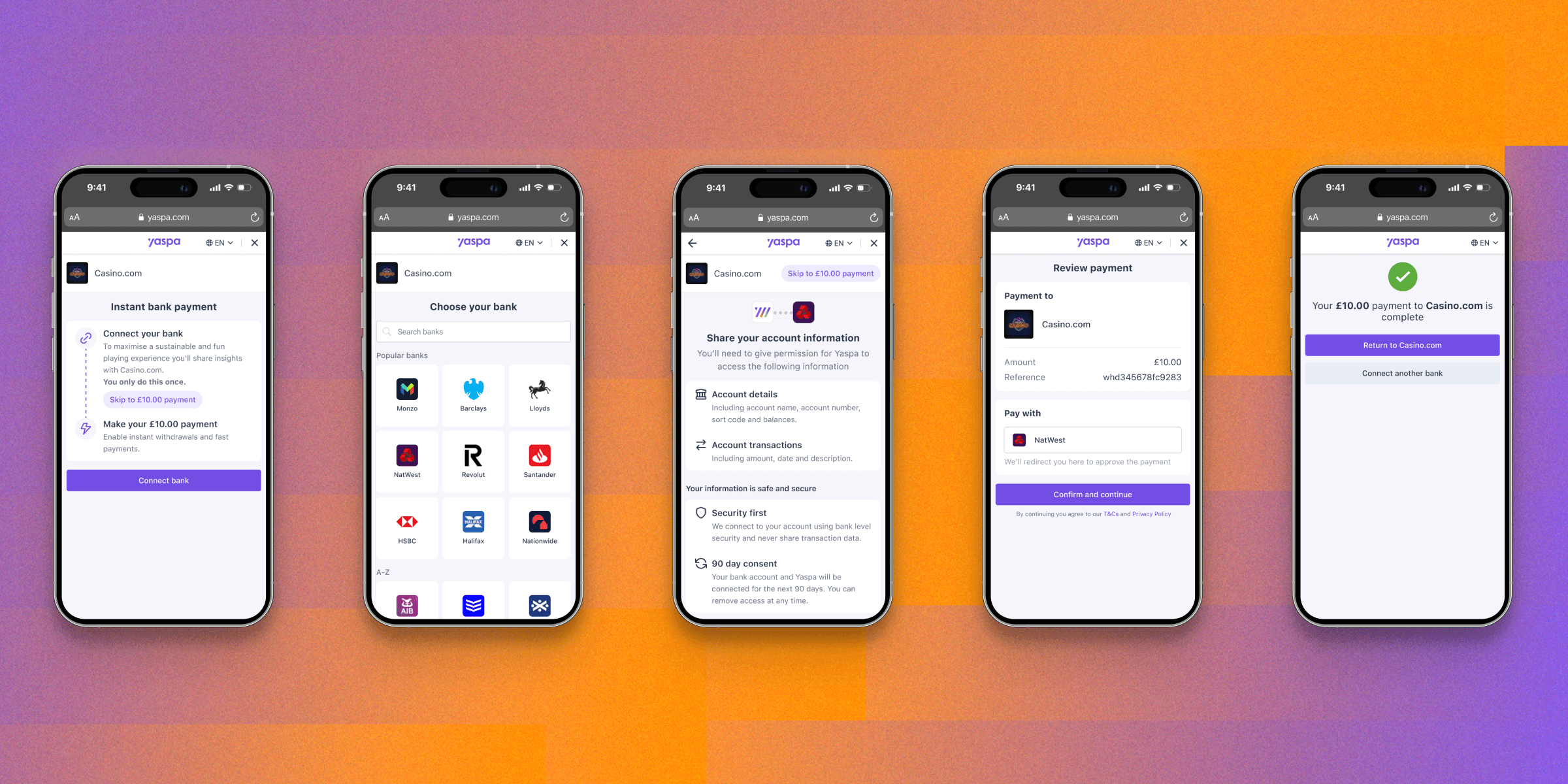
Using Open Banking technology we created a product where users consent to share bank data and make a deposit. This data is used to generate insights which help operators make more informed decisions around their customers. We ran a pilot study with a UK operator for 1 month. 60% of customers who made a payment with Yaspa also consented to sharing data. Total conversion for the longer IP journey only saw a 2% conversion reduction compared to our normal, shorter payment only journey.
Background
Typically when online gamblers hit spending or loss thresholds their accounts are blocked pending enhanced due diligence. Users are asked to manually submit bank statements which is frictionful and has a low conversion. Yaspa could use Open Banking technology to gather this information and use it to provide operators with more meaningful insights.
Open Banking is made up of two core components, Account Information Services (AIS) and Payment initiation Services (PIS). AIS enables sharing banking financial information with a third party and PIS enables instant, account to account bank transfers.
Yaspa worked with academics and domain specialists to come up with over 50 markers of harm from this financial information. These markers can be tracked over time to see and predict when a user might be experiencing gambling related harm.
We had been having conversations with a Tier 1 UK operator about their low conversion for bank statement uploads. They mentioned they had feedback from customers saying they would be more inclined to share data at the point of deposit instead of at the point of friction.
We had no idea how end users would respond to sharing bank data for gambling harm prevention so I mocked up a prototype to use as a talking point and conducted 10 interviews which included a usability test component.
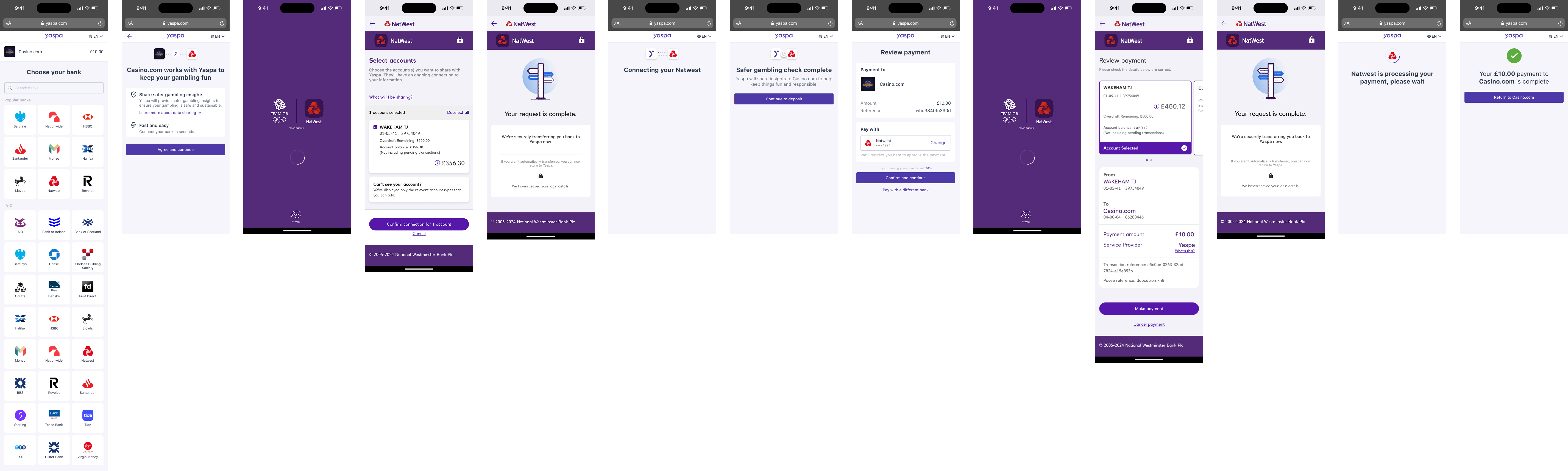
I used thematic analysis to find commonalities is what the participants were saying.
Usability study results showed users were confused why they were going to their banking app twice. They thought they’d be making a payment so the extra step of AIS was confusing.
Interview results show that although all groups thought it’s a good idea to prevent gambling related harm most users will never experience gambling related harm so don’t think this product is for them and would drop out of the flow.
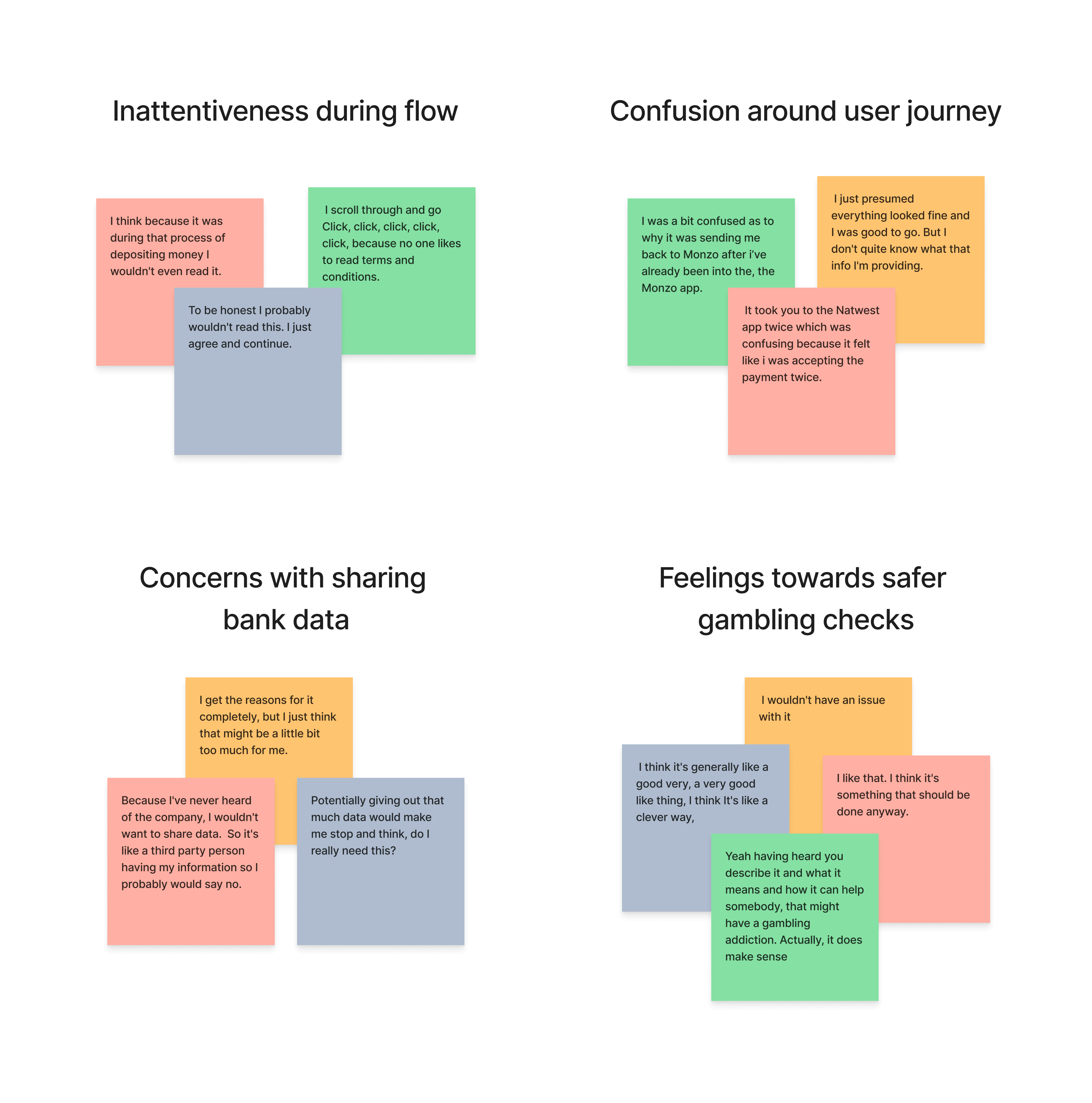
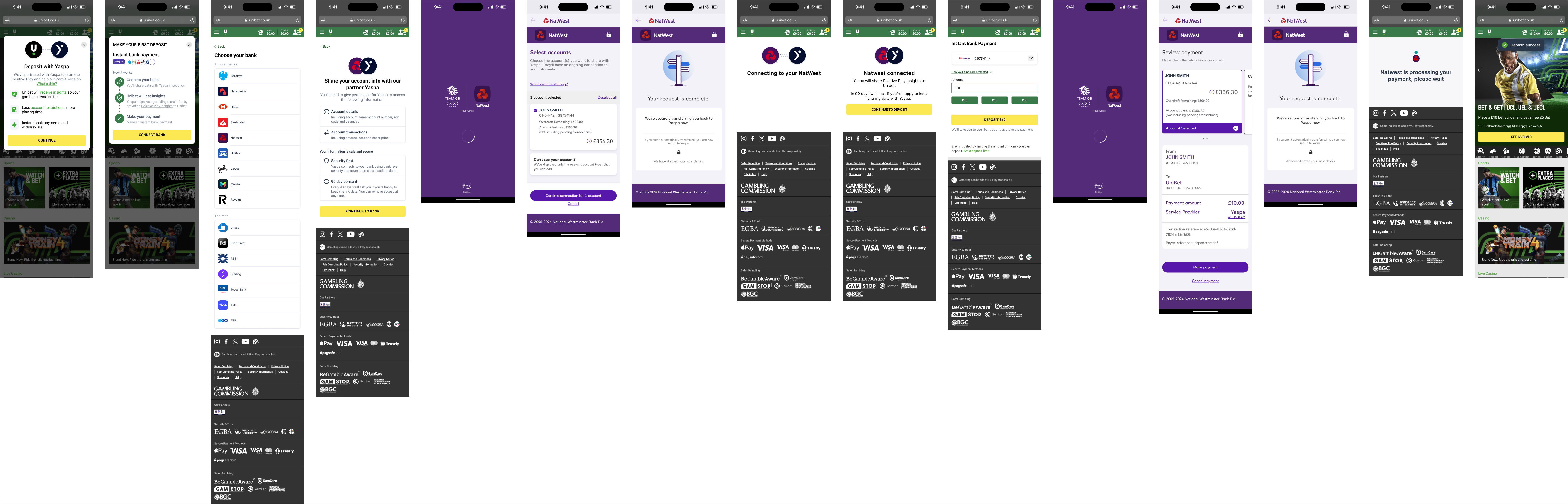
With this feedback we made some key changes. We added a pre positioning screen to clearly sign post the 2 step process of AIS then PIS as well as making the language around data sharing clearer. We changed our messaging away from harm prevention to focus more on enhancing a positive and fun experience as well as allowing users to skip the data sharing part and go straight to the deposit.
Joint research
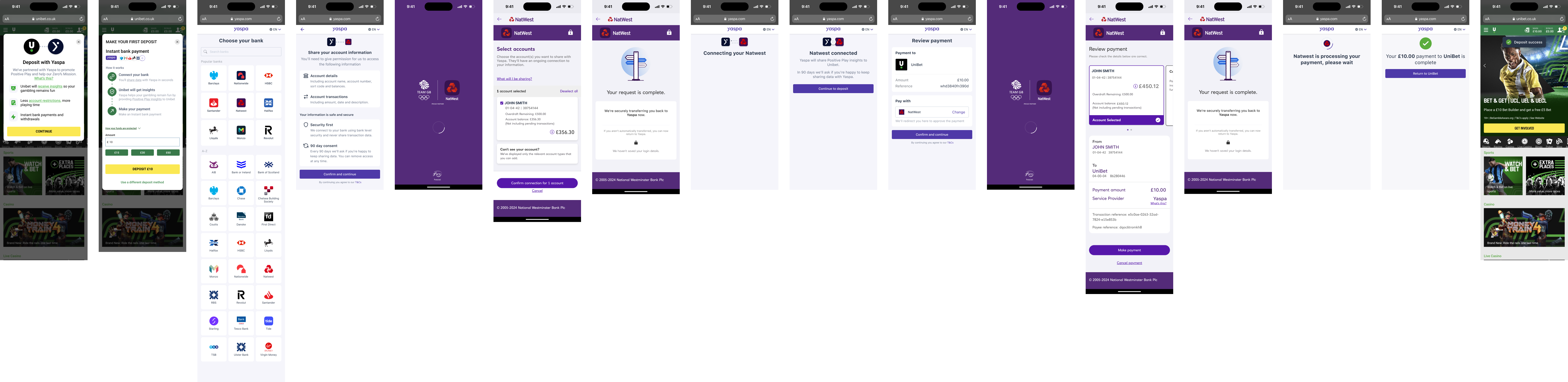
We worked with a Tier 1 UK operator to collaborate on a research project. We used our previous findings to iterate on the design and sent out a survey to the operator's customer base. The survey reached 53,603 customers and 667 users responded. We compared a fully embedded flow to a Yaspa hosted flow as we had an assumption gamblers would trust their operator more compared to Yaspa, a brand they've never heard of, and be more willing to complete the full journey. We wanted to really focus on the copy so questions involved asking about individual screens content.
Results
The message and the language throughout the pricess is clear and easy to understand.
The new Unibet flow is the preferred option compared to the Yaspa flow.
When users are presented with the screens about sharing account information the percentage of users who are unlikely to continue the deposit process increases. Most likely because there is a fear of using a 3rd party provider in the deposit process and lack of familiarity of Yaspa
Understanding what Positive Play means increaseds the likelihood of users to continue with the deposit process compared to after they've first been introduced to the deposit flow
Initially the lengthy process discourages users from completing the deposit, however knowing they only need to go through it once every 90 days can motivate them to proceed
Pilot
With this feedback we iterated on the designs one more time and created a pre positioning screen within Yaspas domain and also added a feature to allow users to Skip the AIS and go straight to the payment.
We worked with one of our existing merchants to pilot the Intelligent payment flow. The pilot ran for 10 days in which time 45% of users consented to sharing their data - far beyond the 5%-10% seen for bank statement uploads. 1st time user conversion was 33% however it’s worth noting if a user doesn’t convert in the full flow the 1st time they’re not lost customers because total conversion was 92% compared to 94% for our normal payment journey.
Next steps
We’re currently live with 3 more merchants across different countries in Europe to gather more quantitative data. Are there any differences across Europe?
Improve 1st time conversion. Where and why are users dropping out of the 1st time user flow. We're implementing an exit survey to gather user feedback at the point they exit the journey.
